Top 10 High-Paying AI Skills to Learn in 2026
Artificial intelligence has moved far beyond being a niche technology. It is now changing how businesses build products, analyze information, automate processes, and serve customers. As AI adoption continues to grow in 2026, professionals with practical AI skills are becoming increasingly valuable across industries.
Learning the right AI skills can open doors to higher-paying roles and help professionals stay competitive as technology evolves. Whether you’re starting your career, changing fields, or looking to upgrade your current skill set, focusing on in-demand AI capabilities can make a significant difference.
Here are 10 high-paying AI skills worth learning in 2026.
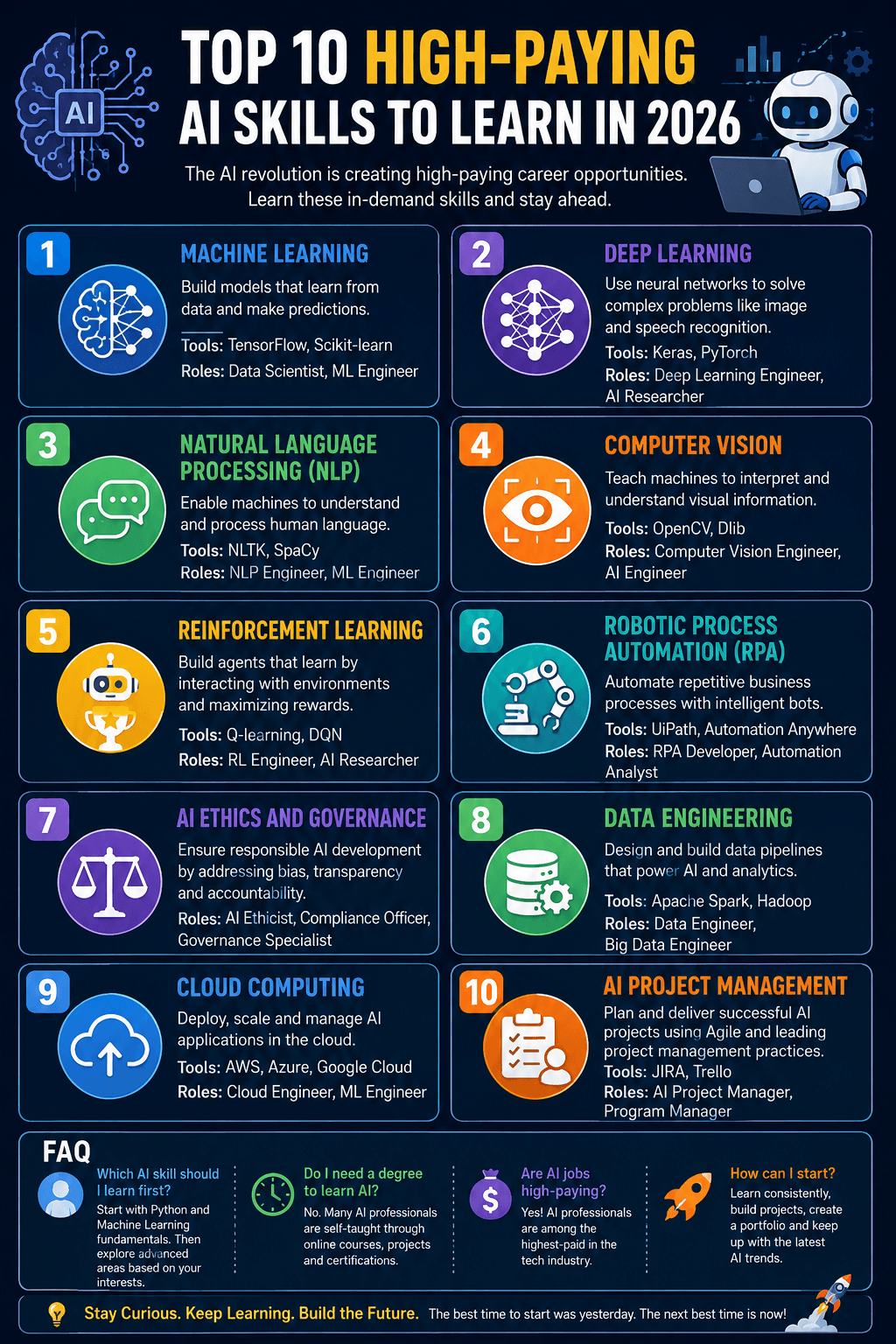
1. Machine Learning
Machine learning is one of the foundations of modern AI. It allows computers to learn from data and make predictions or decisions without being explicitly programmed for every task.
Two common approaches are supervised learning, where models learn from labeled data, and unsupervised learning, where algorithms identify patterns in unlabeled data.
Popular tools include TensorFlow and Scikit-learn. Professionals with machine learning skills can pursue careers as Machine Learning Engineers, Data Scientists, AI Engineers, and Research Scientists.
2. Deep Learning
Deep learning is a specialized area of machine learning that uses neural networks with multiple layers to process complex information. It powers many of the AI applications people use every day, including image recognition, speech recognition, recommendation systems, and generative AI.
Frameworks such as PyTorch and Keras make it easier to build and train deep learning models.
Because deep learning plays a major role in modern AI development, professionals with strong skills in this area can qualify for highly competitive positions such as Deep Learning Engineer, AI Researcher, and Machine Learning Engineer.
3. Natural Language Processing (NLP)
Natural Language Processing, or NLP, focuses on helping computers understand and work with human language.
NLP is behind technologies such as chatbots, virtual assistants, translation tools, search systems, and sentiment analysis. As businesses increasingly use AI to communicate with customers and process large amounts of text, demand for NLP expertise continues to grow.
Useful tools and libraries include NLTK and spaCy, while modern NLP work often involves transformer-based models and large language models.
Career opportunities include NLP Engineer, AI Engineer, Machine Learning Engineer, and Computational Linguist.
4. Computer Vision
Computer vision enables machines to interpret and understand visual information such as images and videos. It has applications across industries, from medical imaging and autonomous vehicles to manufacturing, retail, and security.
Some of the most important computer vision techniques include image classification, object detection, image segmentation, and facial recognition.
Tools such as OpenCV and Dlib are widely used for computer vision projects. Professionals with these skills can find opportunities in areas such as healthcare, robotics, automotive technology, security, and industrial automation.
5. Reinforcement Learning
Reinforcement learning takes a different approach to AI. Instead of learning from labeled examples, an agent learns by interacting with an environment and receiving rewards or penalties based on its actions.
This approach has been used in robotics, game development, autonomous systems, recommendation systems, and optimization problems.
Important concepts and algorithms include Q-learning and Deep Q-Networks (DQN).
Although reinforcement learning is more specialized than some other AI skills, it can be particularly valuable for professionals working on advanced AI research, robotics, autonomous systems, and intelligent decision-making applications.
6. Robotic Process Automation (RPA)
Robotic Process Automation, or RPA, uses software bots to automate repetitive, rule-based business tasks. When combined with AI, RPA can help organizations automate more complex workflows and improve efficiency.
Popular platforms include UiPath and Automation Anywhere.
RPA skills can be useful for roles in business automation, operations, consulting, IT, and process improvement. Professionals who understand both automation and AI can help companies reduce manual work, improve productivity, and streamline business processes.
7. AI Ethics and Governance
As AI becomes more powerful and widely used, companies need people who understand how to develop and deploy these systems responsibly.
AI ethics and governance covers issues such as algorithmic bias, privacy, transparency, accountability, security, and regulatory compliance. Organizations increasingly need frameworks that help them manage the risks associated with AI while still taking advantage of its benefits.
Career paths in this area include AI Governance Specialist, AI Ethics Specialist, Responsible AI Lead, Risk Manager, and Compliance Professional.
For people interested in the intersection of technology, policy, law, and business, AI governance could become an increasingly valuable career path.
8. Data Engineering
AI is only as effective as the data behind it. Data engineers play a critical role by building the systems that collect, process, organize, and deliver data to AI and analytics teams.
Important skills include data warehousing, ETL/ELT pipelines, database management, data architecture, and distributed computing.
Technologies such as Apache Spark and Hadoop are commonly associated with large-scale data processing, while modern data engineering also involves cloud platforms, data lakes, and real-time processing systems.
As organizations generate more data and adopt more AI applications, skilled data engineers remain essential to the AI ecosystem.
9. Cloud Computing
Building an AI model is only part of the job. Organizations also need reliable infrastructure to train, deploy, monitor, and scale those models.
That makes cloud computing an important complementary skill for AI professionals. Familiarity with platforms such as Amazon Web Services (AWS), Microsoft Azure, and Google Cloud can help professionals deploy AI applications and manage the infrastructure they depend on.
AI engineers, cloud engineers, machine learning engineers, and data professionals can all benefit from cloud expertise.
Combining AI knowledge with cloud computing can be especially valuable because companies increasingly want AI systems that can operate reliably at scale.
10. AI Project Management
AI projects involve more than technical development. Successful projects require planning, communication, budgeting, risk management, and coordination between technical and non-technical teams.
AI project managers need to understand how AI development works while also being comfortable managing Agile workflows, timelines, stakeholders, and cross-functional teams.
Tools such as Jira and Trello can support project planning and collaboration.
Professionals who combine project management experience with a solid understanding of AI can move into roles such as AI Project Manager, AI Program Manager, Technical Program Manager, or AI Product Manager.
(FAQ)
1. Which AI skill is most in demand in 2026?
Machine learning, generative AI, deep learning, natural language processing, data engineering, and cloud computing are among the most valuable AI-related skills. The best choice depends on your career goals and existing technical background.
2. What is the highest-paying AI skill?
There isn’t one single highest-paying AI skill. Advanced expertise in areas such as machine learning, deep learning, generative AI, AI engineering, and AI infrastructure can lead to highly paid roles, especially at senior and specialized levels.
3. Can I learn AI without a computer science degree?
Yes. A computer science degree can help, but it isn’t always required. Many AI professionals build their careers through online courses, practical projects, certifications, and hands-on experience.
4. How long does it take to learn AI skills?
The timeline depends on your starting point and the skill you’re learning. Beginners may need several months to develop basic competency, while becoming job-ready in advanced areas such as machine learning or deep learning can take considerably longer.
5. Which AI skill should beginners learn first?
Python and machine learning fundamentals are good starting points for many beginners. Once you understand programming, statistics, data handling, and basic machine learning concepts, you can move into areas such as deep learning, NLP, computer vision, or generative AI.