How to Find a Remote Job | Remote Career Guide | Tarauli
How to Find a Remote Job
Finding a remote job is not simply a matter of typing “Remote” into a job-search box and applying to everything that appears.
A better approach is to decide what you want, identify employers that actually hire remotely, build an application around the skills they need, and verify the job before you apply.
Remote work is also broader than one specific type of job. Software engineers, designers, marketers, customer-support professionals, data specialists, salespeople, writers, project managers, and many other professionals can find remote opportunities.
In the U.S., Bureau of Labor Statistics data show that 35.4 million people teleworked or worked at home for pay in 2026, representing 22.4% of people at work. The percentage was considerably higher among management, professional, and related occupations.
That does not mean every job can be done remotely—or that every remote listing allows people to work from anywhere. Location restrictions, time zones, employment laws, tax requirements, and company policies still matter.
So, how do you actually find a remote job?
The most effective process is:
Choose a target → prepare your application → search strategically → research employers → apply selectively → prepare for interviews → repeat and improve.
What Is a Remote Job?
A remote job is a position where an employee performs some or all of their work away from the employer’s physical office.
That can mean working entirely from home, working from another approved location, or working as part of a distributed team.
However, “remote” does not always mean “work from anywhere.”
A company may advertise a position as remote while requiring employees to:
- Live in a particular country
- Live in a specific state or region
- Work within certain time zones
- Be available during particular business hours
- Travel occasionally
- Meet employment or tax requirements
- Work from an approved location
This distinction is one of the first things you should check when searching for remote jobs.
A listing that says “Remote — United States” may not be available to someone living in another country. Similarly, an “international remote” position may still have restrictions based on where the company can legally employ people.
Remote vs. Hybrid vs. Work From Home
These terms are related, but they are not interchangeable.
| Work Arrangement | What It Usually Means |
|---|---|
| Fully Remote | Work is performed remotely rather than from a company office |
| Remote-First | The company is designed around remote work, even if offices exist |
| Hybrid | Employees divide their time between remote work and an office |
| Work From Home | Work is performed from home, either permanently or for some working days |
| Location-Restricted Remote | The employee works remotely but must live in a particular location |
Always read the job description carefully instead of relying only on the word “remote.”
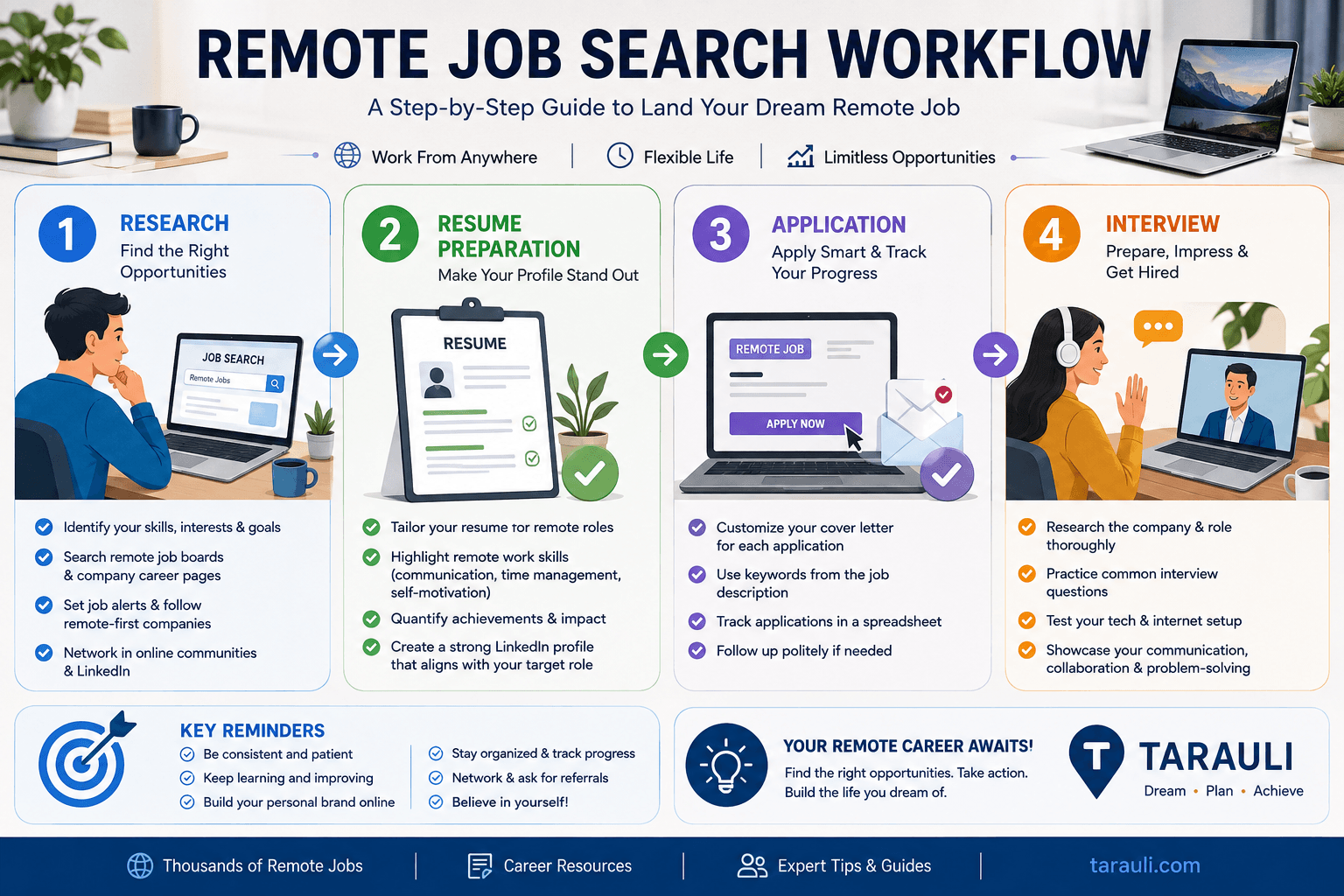
How to Find a Remote Job: Step-by-Step
1. Decide What Type of Remote Job You Want
Before searching, narrow down the type of work you are looking for.
Searching for “remote jobs” alone can produce an enormous range of positions. A more focused search makes it easier to identify relevant opportunities.
Start with five questions:
- What role do I want?
- What skills do I have?
- What industry interests me?
- Where am I allowed to work?
- What level of experience do I have?
For example, instead of searching for:
Remote jobs
try:
Remote Python Developer
or:
Remote Product Marketing Manager
or:
Remote Customer Support Specialist
or:
Remote Data Analyst
You can make the search even more specific by adding a location, industry, seniority level, or technology.
For example:
- Remote Senior Software Engineer
- Remote Java Developer USA
- Entry-Level Remote Data Analyst
- Remote Cybersecurity Engineer
- Remote AI Engineer
- Remote Content Writer
- Remote Customer Success Manager
The goal is not to apply to the largest possible number of jobs.
The goal is to find jobs where your experience actually fits the employer’s needs.
2. Identify Remote-Friendly Career Fields
Remote work is available across many industries, but the number of opportunities varies considerably by occupation.
BLS data shows that telework is particularly common among management, professional, and related occupations. In its 2025 annual averages, 37.2% of people working in that broad occupational group teleworked or worked at home for pay.
Some fields worth exploring include:
Software Engineering
Common roles include:
- Software Engineer
- Backend Engineer
- Frontend Engineer
- Full Stack Developer
- DevOps Engineer
- Cloud Engineer
- Mobile Developer
- Platform Engineer
Useful skills can include programming languages, APIs, databases, Git, cloud platforms, testing, and system design.
Data
Possible roles include:
- Data Analyst
- Data Scientist
- Analytics Engineer
- Business Intelligence Analyst
- Data Engineer
Common skills include SQL, Python, statistics, data visualization, databases, and analytics platforms.
Artificial Intelligence and Machine Learning
Examples include:
- Machine Learning Engineer
- AI Engineer
- Research Engineer
- Applied Scientist
- ML Platform Engineer
Depending on the role, employers may look for Python, machine learning frameworks, statistics, cloud infrastructure, data engineering, or model deployment experience.
Cybersecurity
Remote opportunities can include:
- Security Engineer
- Security Analyst
- Cloud Security Engineer
- Application Security Engineer
- Detection Engineer
- Security Consultant
Design
Examples include:
- Product Designer
- UX Designer
- UI Designer
- UX Researcher
- Visual Designer
Marketing
Remote marketing roles may include:
- SEO Specialist
- Content Strategist
- Growth Marketer
- Performance Marketing Manager
- Social Media Manager
- Product Marketing Manager
Sales
Possible positions include:
- Account Executive
- Sales Development Representative
- Business Development Representative
- Sales Engineer
- Customer Success Manager
Customer Support
Remote support teams commonly hire for:
- Customer Support Specialist
- Technical Support Specialist
- Customer Success Specialist
- Support Engineer
Other Remote Careers
You can also find remote opportunities in:
- Finance
- Accounting
- Operations
- Recruiting
- Human Resources
- Writing
- Editing
- Project Management
- Education
- Administration
The important point is that remote availability depends on the specific employer and position. A career field may support remote work without every job within that field being remote.
3. Build a Remote-Ready Resume
You do not necessarily need previous remote employment to apply for remote jobs.
What matters is showing that you can produce results, communicate effectively, manage your responsibilities, and work with the level of independence the role requires.
A strong remote resume should make your relevant skills easy to identify.
Highlight measurable results
Instead of:
Managed social media accounts.
Consider:
Managed social media campaigns across three platforms and increased organic engagement by 42%.
Instead of:
Worked on a software project.
Consider:
Built and deployed a customer-facing web application using React and Node.js.
Specific results are easier for recruiters to understand.
Show remote-work skills
If you have experience with:
- Distributed teams
- Slack
- Microsoft Teams
- Zoom
- Google Workspace
- GitHub
- Jira
- Notion
- Asana
- Remote client communication
- Asynchronous collaboration
Mention the tools and the context in which you used them.
Do not simply create a giant list of software.
Show how you used the tools to accomplish something.
Highlight independent work
Remote employers often need people who can move work forward without constant supervision.
You can demonstrate this by describing:
- Projects you owned
- Problems you solved independently
- Processes you improved
- Cross-functional work you coordinated
- Projects you delivered under deadlines
4. Create or Improve Your Online Professional Profile
Your resume is not the only place employers may evaluate you.
Depending on your career, your online presence might include:
- Professional networking profiles
- GitHub
- Portfolio websites
- Behance
- Dribbble
- Personal websites
- Writing portfolios
- Published work
- Professional communities
Make sure your online profile tells the same story as your resume.
If your target is a remote software engineering position, for example, your profile should make it easy to understand:
- What you build
- Which technologies you use
- What experience you have
- What types of roles you want
- Which projects demonstrate your skills
If you are a designer, your portfolio may matter more than a long list of tools.
If you are a writer, published work may be more persuasive than a traditional portfolio.
The best profile is not necessarily the longest one.
It is the one that quickly answers:
“What can this person do for us?”
5. Search for Remote Jobs Strategically
There are several ways to find remote employment.
You can search:
- Remote job boards
- Company career pages
- Professional networking platforms
- Recruiter listings
- Industry communities
- Referrals
- Professional networks
- Search engines
A dedicated remote job board can make the process easier because you can begin with opportunities that already identify remote work as part of the position.
For example, you can browse remote jobs on Tarauli and narrow your search based on the roles that match your experience.
Do not rely on only one source.
A useful strategy is to combine:
Job boards + company career pages + networking + referrals
That gives you multiple ways to discover opportunities.
6. Use Better Remote Job Search Keywords
One of the simplest ways to improve your job search is to become more specific.
Instead of searching only for:
Remote jobs
Try combinations such as:
- Remote Software Engineer
- Remote Backend Engineer
- Remote React Developer
- Remote Python Developer
- Remote Data Analyst
- Remote Machine Learning Engineer
- Remote Product Manager
- Remote UX Designer
- Remote SEO Specialist
- Remote Customer Support
- Remote Sales Development Representative
- Remote Finance Manager
You can also combine a role with a location:
- Remote Software Engineer USA
- Remote Developer Europe
- Remote Jobs Canada
- Remote Marketing Jobs USA
Or combine a role with experience:
- Entry-Level Remote Software Engineer
- Junior Remote Data Analyst
- Senior Remote Product Manager
- Remote Jobs for Beginners
Search terminology varies between employers, so experiment with related job titles.
For example, a company may call a position “Customer Success Manager” while another calls a similar role “Client Success Manager.”
Using several related searches can uncover opportunities you might otherwise miss.
7. Research Companies Before Applying
Finding a promising job description is only half the process.
You should also understand who you are applying to.
Before submitting an application, check:
- The company’s official website
- It’s careers page
- The job description
- Company location
- Remote-work policy
- Required location
- Employment type
- Compensation information
- Benefits
- Role responsibilities
- Company background
If a remote position interests you, research whether the employer actually supports remote employees rather than assuming the word “remote” tells the whole story.
You can also use Tarauli’s company profiles to research employers and understand their business, industry, technology, and remote-work information where available.
Pay attention to the location requirement
This is particularly important for international job seekers.
“Remote” can mean:
- Remote within the United States
- Remote within a particular country
- Remote within a particular region
- Remote within selected countries
- Remote worldwide
These are very different arrangements.
If you live outside the employer’s permitted hiring area, a strong application may still be rejected because of employment, payroll, tax, or regulatory restrictions.
8. Tailor Your Application
One of the biggest mistakes in a remote job search is treating every application exactly the same.
A better approach is to adjust your application around the employer’s needs.
Suppose a job description emphasizes:
- Python
- AWS
- PostgreSQL
- APIs
- Distributed teams
Your resume should make relevant experience with those areas easy to find—assuming you genuinely have it.
Do not copy the job description word for word.
Instead, translate your real experience into language that clearly matches the role.
Before
Worked on backend systems.
Better
Developed and maintained Python-based backend services and REST APIs, working with PostgreSQL and cloud infrastructure.
The second version gives the employer more useful information.
The same principle applies outside technology.
If a marketing role emphasizes SEO, analytics, and content strategy, highlight relevant campaigns, results, and projects.
If a customer-support position emphasizes customer retention, ticket management, and communication, make relevant experience visible.
Tailoring does not mean exaggerating.
It means making relevant experience easier to see.

9. Prepare for Remote Interviews
Remote interviews can happen through video calls, phone calls, technical assessments, portfolio reviews, or multiple interview rounds.
Preparation matters just as much as it does for an office-based position.
Before the interview:
- Test your microphone
- Test your camera
- Check your internet connection
- Choose a quiet location
- Keep your resume nearby
- Review the job description
- Research the company
- Prepare examples of your work
- Prepare questions for the interviewer
Also check the interview time carefully.
If the company is in another country, confirm the time zone rather than assuming the calendar invitation is in your local time.
Prepare stories, not memorized speeches
Think about examples that demonstrate:
- A difficult problem you solved
- A project you completed
- A conflict you handled
- A deadline you met
- A mistake you learned from
- A time you worked independently
- A time you collaborated across teams
Remote employers may also ask about communication and organization.
For example:
“How do you stay organized when working independently?”
A strong answer should explain your actual process rather than simply saying:
“I’m very organized.”
10. Demonstrate Remote Work Skills
Working remotely requires more than being comfortable at home.
Employers need people who can communicate, prioritize, collaborate, and keep work moving without constant in-person supervision.
Important skills include:
Written Communication
Remote teams rely heavily on written communication.
Show that you can explain:
- What you completed
- What you are working on
- What is blocked
- What you need from someone else
- What happens next
Time Management
You should be able to organize your workload and meet deadlines without someone physically checking on you.
Accountability
If something goes wrong, good remote workers communicate early rather than allowing a problem to remain hidden.
Asynchronous Collaboration
Not every question needs an immediate meeting.
Strong distributed teams often use written updates, documentation, project-management systems, and recorded information to reduce unnecessary meetings.
Documentation
Being able to document decisions, processes, technical systems, and project information is especially useful when teammates are working in different locations.
11. Follow Up After Applying
Following up can be appropriate, but it should be professional and limited.
If you have a legitimate contact at the company, a short message can confirm your interest.
For example:
“I recently applied for the Software Engineer position and wanted to briefly reiterate my interest. My experience building backend services with Python and AWS closely matches the role’s requirements. Thank you for your consideration.”
Avoid sending multiple messages across several channels.
If the company says it will contact candidates after a specific period, give them that time.
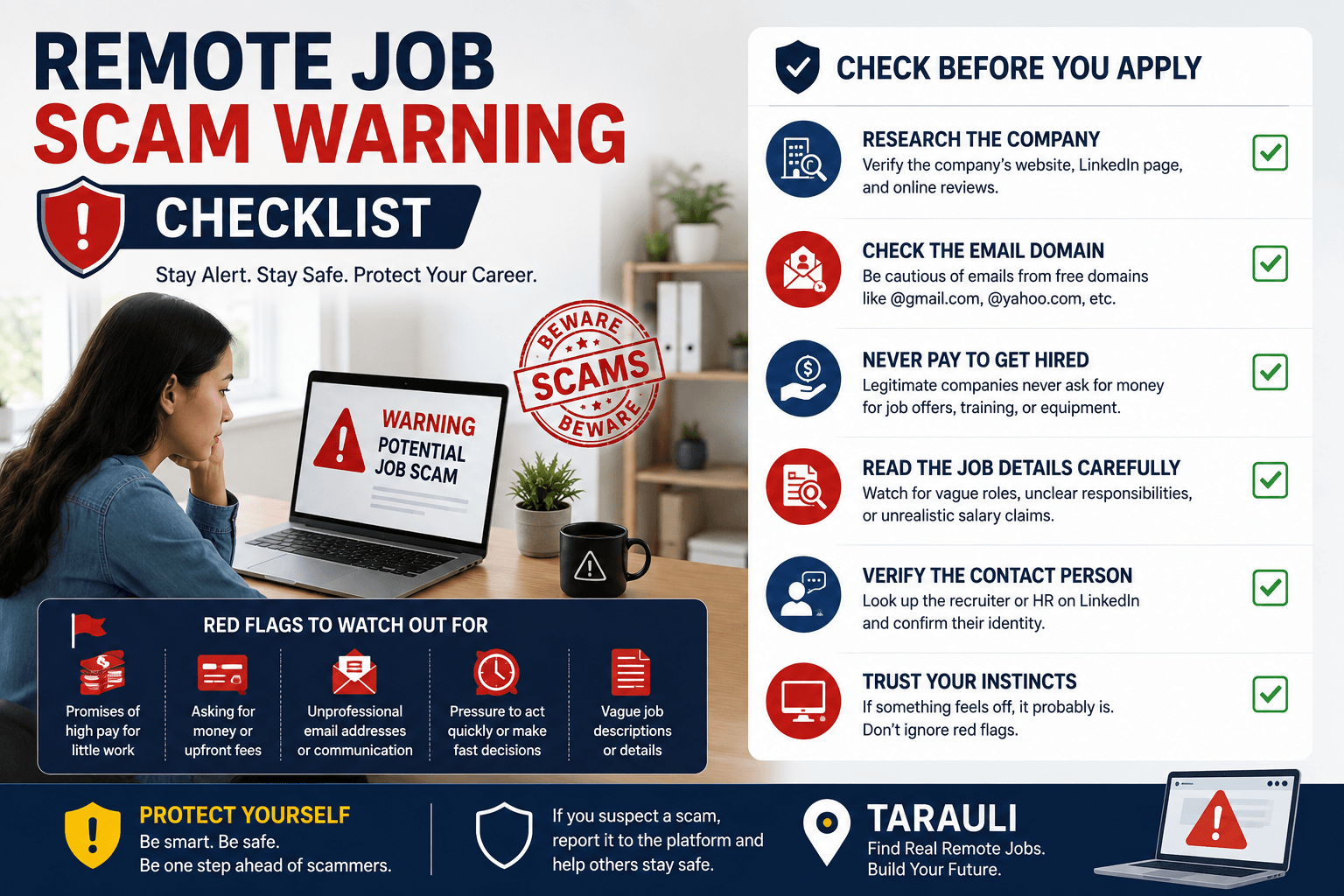
12. Avoid Remote Job Scams
Remote jobs are attractive to legitimate employers—and unfortunately, to scammers too.
The Federal Trade Commission warns that work-from-home scammers may promise large amounts of money with little effort and may try to obtain your money or personal information.
Some current scams have also involved fake recruiters contacting people through text messages and pretending to represent legitimate companies. The FTC specifically warns against unexpected job messages that ask people to engage, deposit money, or perform questionable online tasks.
Warning signs include:
- Being asked to pay money to get a job
- Being asked to purchase equipment through a specific seller
- Requests for gift cards
- Requests to deposit a check and send money back
- Unusually high compensation for minimal work
- Pressure to make an immediate decision
- Suspicious recruiter email addresses
- Vague company information
- Interviews conducted entirely through unusual messaging channels
- Requests for sensitive financial information before a legitimate hiring process has been established
The FTC’s advice is straightforward: never pay money in exchange for the promise of a job.
Verify the employer
Before accepting an offer:
- Visit the company’s official website.
- Find its careers page independently.
- Search for the position there.
- Verify the recruiter’s identity.
- Check the email domain carefully.
- Research the company and recruiter.
- Be cautious with unexpected text or messaging-app offers.
- Never send money to secure employment.
If something feels rushed or unusually easy, slow down and verify it.
Best Types of Remote Jobs
There is no single “best remote job.”
The right role depends on your skills, experience, interests, location, and career goals.
Here are some of the major categories to consider:
| Job Category | Example Roles | Common Skills |
| Software Engineering | Software Engineer, Backend Engineer | Programming, APIs, Git |
| Data | Data Analyst, Data Scientist | SQL, Python, Statistics |
| AI & Machine Learning | ML Engineer, AI Engineer | Python, ML, Data |
| Cybersecurity | Security Engineer, Security Analyst | Security, Cloud, Networking |
| Design | Product Designer, UX Designer | Figma, UX Research |
| Marketing | SEO Specialist, Content Strategist | SEO, Analytics, Content |
| Sales | Account Executive, SDR | Communication, CRM |
| Customer Support | Support Specialist, Support Engineer | Communication, CRM |
| Product | Product Manager, Product Operations | Research, Strategy, Communication |
| Finance | Accountant, Financial Analyst | Finance, Excel, Analysis |
| Operations | Operations Manager, Operations Specialist | Organization, Process Management |
| Writing | Technical Writer, Content Writer | Writing, Research, Editing |
| Project Management | Project Manager, Program Manager | Planning, Communication |
Remember that remote availability varies by employer and position.
Where to Find Remote Jobs
A strong remote job search usually combines several channels rather than relying on one website.
1. Remote Job Boards
Remote-focused job boards can save time because they make remote opportunities easier to discover.
You can browse remote jobs on Tarauli and search for opportunities based on your target career.
2. Company Career Pages
Some employers publish positions directly on their own websites.
If you already know which companies you want to work for, create a list and check their careers pages regularly.
3. Professional Networking
Networking can help you discover opportunities that you would not find through traditional applications alone.
Connect with:
- Former colleagues
- Industry professionals
- Recruiters
- Hiring managers
- Alumni
- People working at companies you are interested in
Networking does not have to mean asking strangers for jobs.
A thoughtful conversation about a field, project, or company can be much more natural.
4. Referrals
A referral can help your application reach the right person, but it should come from a genuine professional relationship.
Build relationships before you need them.
5. Industry Communities
Depending on your career, professional communities can be useful sources of opportunities.
Developers might find opportunities through technical communities or open-source networks.
Designers may discover work through portfolio communities.
Marketers may find opportunities through industry groups.
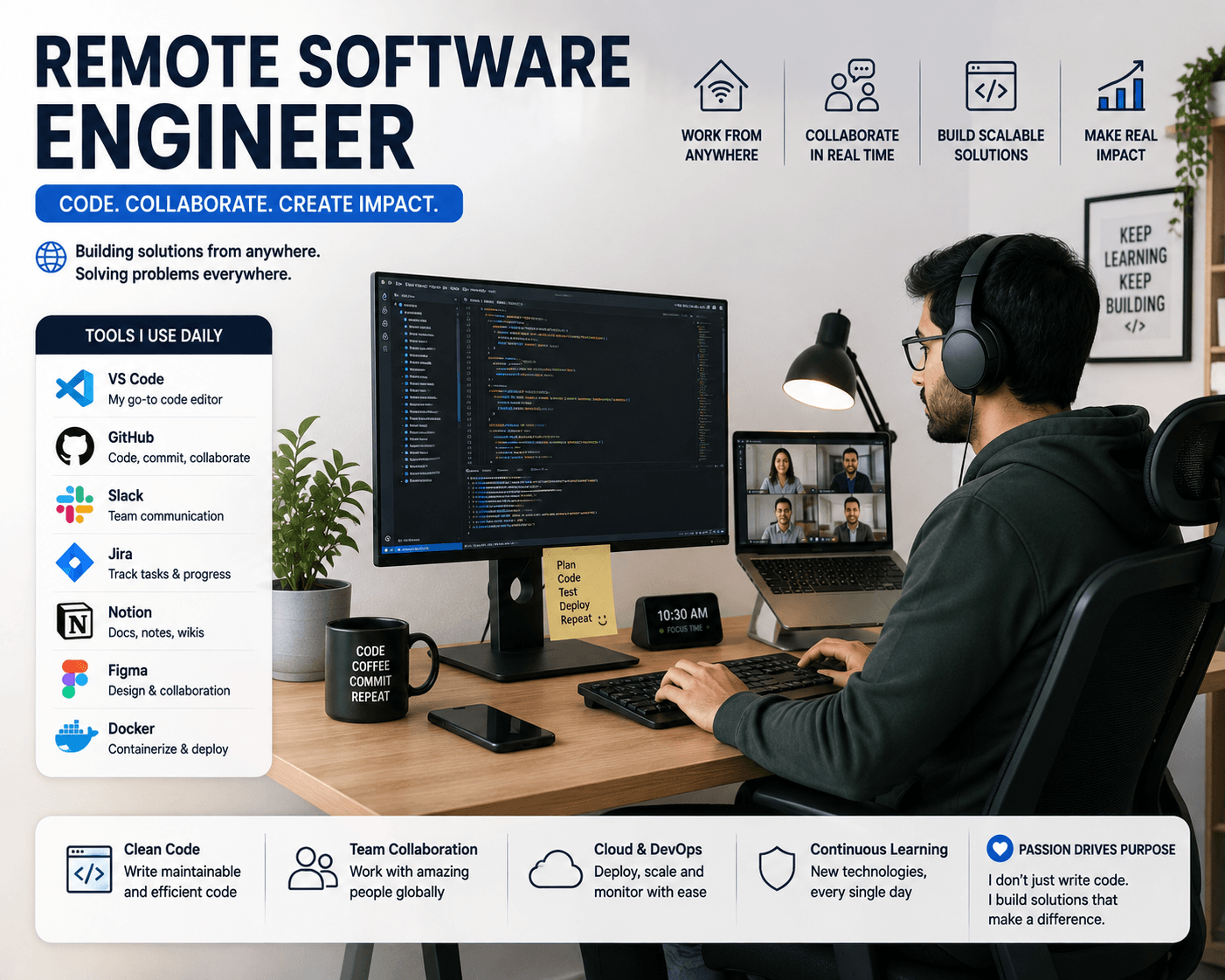
How to Find Remote Software Engineering Jobs
Software engineering remains one of the most recognizable remote career categories.
If you are targeting remote software engineering jobs, search using specific technologies and role names.
For example:
- Remote Software Engineer
- Remote Backend Engineer
- Remote Frontend Engineer
- Remote Full Stack Developer
- Remote Python Developer
- Remote Java Developer
- Remote React Developer
- Remote DevOps Engineer
- Remote Cloud Engineer
- Remote Platform Engineer
You can browse remote software engineering jobs on Tarauli to continue your search.
Build a strong technical profile
Depending on your target role, emphasize relevant experience with:
- Programming languages
- Frameworks
- APIs
- Databases
- Cloud platforms
- Git
- Testing
- CI/CD
- Infrastructure
- Security
- System design
A portfolio can also help, particularly for junior developers or people changing careers.
Instead of building ten unfinished projects, consider creating a smaller number of projects that demonstrate useful skills.
For example:
A full-stack application with authentication, database integration, API development, testing, deployment, and documentation.
That gives an employer much more information than a simple “todo app.”
How Much Do Remote Jobs Pay?
Remote work does not have one standard salary range.
Compensation can depend on:
- Job title
- Seniority
- Industry
- Skills
- Employer
- Location
- Employment type
- Experience
- Company compensation philosophy
A remote position may pay based on the employee’s location, the employer’s salary bands, or another compensation structure.
This is one reason you should read the job description carefully.
Also distinguish between:
- Salary
- Hourly pay
- Contract rates
- Bonuses
- Commission
- Equity
- Benefits
When evaluating an offer, consider the entire compensation package rather than looking only at the headline salary.
For additional salary information and remote compensation resources, explore Tarauli’s salary section.
Can You Get a Remote Job From Another Country?
Sometimes—but not automatically.
A company may hire internationally, but that does not mean it can employ someone in every country.
International remote employment can involve questions around:
- Employment law
- Payroll
- Tax
- Benefits
- Worker classification
- Time zones
- Data security
- Immigration or work authorization
- Local regulations
The exact rules depend on the countries involved and the employment arrangement.
For example, U.S. tax guidance distinguishes between different situations involving people working outside the United States, and worker classification can also depend on the actual working relationship rather than simply the fact that someone works remotely.
If a job says “remote worldwide,” read the details carefully.
If it says “remote in the U.S.,” do not assume international applicants are eligible.
How to Find Remote Jobs With No Experience
Getting your first remote job can be difficult because many employers want evidence that you can perform the work independently.
But you do not necessarily need previous remote employment.
You can build evidence through:
- Freelance projects
- Internships
- Personal projects
- Open-source contributions
- Volunteer work
- University projects
- Certifications
- Portfolio work
- Previous office-based experience
- Contract work
For example, a new developer could create two or three well-documented applications and publish the code on GitHub.
A marketing candidate could build a sample SEO strategy, content plan, or campaign analysis.
A designer could create a small portfolio showing the problem, research, design decisions, and final result.
The goal is to answer:
“Why should an employer trust you to do this job?”
Evidence is usually stronger than simply claiming you have the skill.
How to Make Your Resume Stand Out for Remote Jobs
A strong remote resume should be easy to scan.
Start with:
- Your target role
- Relevant professional experience
- Key skills
- Measurable achievements
- Relevant projects
Avoid filling the top of the resume with generic statements such as:
Hardworking professional seeking an opportunity to utilize my skills.
Instead, make the value you bring clear.
For example:
Backend engineer with five years of experience building Python APIs, cloud-based services, and data-intensive applications.
That immediately tells the reader what you do.
Use job descriptions intelligently
If an employer repeatedly mentions specific skills that you genuinely possess, make sure those skills are visible in your resume.
This helps both human reviewers and applicant-tracking systems understand the relevance of your experience.
But do not add skills simply because they appear in the job description.
If you have never used Kubernetes, for example, do not add Kubernetes to your resume just because the employer listed it.
How to Know if a Remote Job Is Legitimate
Before applying, ask:
Does the company exist?
Find its official website and verify that the business has a real presence.
Does the job exist on the official career site?
If a recruiter contacts you about a position, independently visit the company’s website rather than relying only on the link they provide.
Does the recruiter use a legitimate company email?
Be careful with free email addresses or domains that closely imitate a legitimate company.
Does the compensation make sense?
An unusually large salary for an extremely simple role should make you investigate further.
Are you being asked for money?
Stop.
Legitimate employers should not require you to pay money to obtain a job.
Are you being rushed?
Scammers often create urgency so you have less time to investigate.
The FTC recommends searching for the company or recruiter along with terms such as “scam,” “review,” or “complaint” and talking with someone you trust before accepting a questionable offer.
Common Mistakes to Avoid When Searching for Remote Jobs
Applying to Everything
Sending hundreds of random applications can consume your time without improving your results.
Focus on positions where your experience matches the requirements.
Ignoring Location Restrictions
A job can be remote and still be unavailable in your country or state.
Check the location requirements before applying.
Using One Resume Everywhere
A resume for a software engineering role should not look identical to one for a product management role.
Tailor it.
Failing to Research the Employer
Do not apply based only on a job title and salary.
Understand what the company does and what the position involves.
Overlooking Time Zones
A job may require you to work during specific hours.
Check this before applying.
Claiming Skills You Do Not Have
Keyword stuffing may get you through an initial screen, but it will not help during an interview.
Be accurate.
Ignoring Communication Skills
Remote work depends heavily on communication.
Show employers that you can communicate clearly and reliably.
Focusing Only on Salary
Salary matters, but so do:
- Benefits
- Work hours
- Time-zone expectations
- Job stability
- Career development
- Management
- Workload
- Vacation
- Equity
- Contract terms
Look at the whole opportunity.
How Long Does It Take to Find a Remote Job?
There is no reliable universal timeline.
Some candidates may find a suitable opportunity quickly. Others may spend months searching, especially when targeting competitive roles, specific companies, or international positions.
Your timeline can depend on:
- Your experience
- Your target career
- Industry demand
- Location
- Salary expectations
- Number of suitable openings
- Quality of your resume
- Interview performance
- Networking
- Application strategy
Instead of focusing entirely on how many weeks the search takes, track the parts you can control.
For example:
- How many relevant jobs did you identify?
- How many applications were genuinely tailored?
- How many interviews did you receive?
- Where did applications stop progressing?
- What feedback did you receive?
- What can you improve?
If you submit 50 applications and receive no interviews, simply submitting another 50 identical applications may not solve the problem.
Look for the bottleneck.
A Simple Weekly Remote Job Search Routine
A consistent process is often easier to maintain than searching randomly whenever you have free time.
You could create a weekly routine like this:
Monday: Find New Jobs
Search job boards and company career pages.
Save only positions that genuinely match your experience.
Tuesday: Tailor Applications
Select your strongest opportunities and customize your resume and application.
Wednesday: Research Companies
Learn more about the companies you are considering.
Thursday: Network
Connect with relevant professionals, recruiters, former colleagues, or people in your target industry.
Friday: Follow Up and Improve
Review applications, track responses, practice interview questions, and improve your resume or portfolio.
You do not need to follow this exact schedule.
The important thing is to create a process that you can repeat.
A Better Remote Job Search Strategy
If your current search is not producing results, work through this checklist.
Step 1: Pick one or two target roles
Do not try to become a candidate for everything.
Step 2: Identify your strongest skills
Choose the skills that employers are actually paying for.
Step 3: Improve your resume
Make relevant experience and achievements obvious.
Step 4: Build proof
Use projects, portfolios, case studies, GitHub repositories, published work, or measurable results.
Step 5: Find the right employers
Target companies that actually hire for your location and career level.
Step 6: Apply selectively
Prioritize strong matches.
Step 7: Track your applications
Record:
- Company
- Position
- Date applied
- Location requirement
- Salary
- Application status
- Interview stage
- Follow-up date
Step 8: Learn from rejection
If you repeatedly reach interviews but do not receive offers, improve interview preparation.
If applications repeatedly receive no response, examine your targeting and resume.
Frequently Asked Questions
How do I find a remote job?
Start by choosing a specific target role, identifying employers that hire remotely, preparing a resume around your relevant skills, and searching remote job boards and company career pages. Check the location and eligibility requirements before applying. Tailor applications to the job, prepare for remote interviews, and research employers carefully before accepting an offer.
What is the best way to search for remote jobs?
The strongest approach is usually a combination of remote job boards, company career pages, professional networking, referrals, and industry communities. Use specific search terms instead of searching only for “remote jobs.” For example, search for your job title plus “remote,” along with relevant technologies, experience levels, or locations.
Where can I find legitimate remote jobs?
You can find legitimate remote positions through established job boards, official company career pages, professional networks, recruiters, and industry communities. Always verify the employer independently. If someone asks you to pay money to obtain a job or sends an unexpected offer with unusual payment requests, stop and investigate before providing information.
How can I get a remote job with no experience?
Start by identifying entry-level roles that match your current skills and build evidence through projects, internships, freelance work, volunteer experience, certifications, or portfolios. You can also use previous office-based experience to demonstrate communication, organization, problem solving, and independent work. Focus on proving that you can perform the actual job rather than simply saying you want remote work.
What skills are needed for remote work?
The skills depend on the position, but many remote jobs value clear written communication, time management, organization, accountability, collaboration, problem solving, and the ability to work independently. Technical roles may require programming, data, cloud, cybersecurity, or other specialized skills. The most important approach is to match your skills to the specific position.
How do I know if a remote job is legitimate?
Research the company independently, verify the job on its official website, check the recruiter’s identity and email domain, and read the job description carefully. Never pay money to obtain employment. Be particularly cautious about unexpected text messages, fake checks, unusual payment requests, or promises of very high earnings for very little work.
Can I get a remote job from another country?
Sometimes. Some companies hire internationally, while others restrict remote employees to particular countries or regions. International hiring can involve employment, payroll, tax, worker-classification, and regulatory considerations. Never assume that a position marked “remote” is available worldwide. Read the location requirements carefully and confirm your eligibility with the employer.
How do I make my resume stand out for remote jobs?
Focus on relevant achievements rather than generic responsibilities. Show measurable results, technical or professional skills, independent project ownership, and experience working across teams. If you have worked remotely or with distributed teams, mention that experience. Most importantly, tailor your resume to the actual position instead of sending exactly the same document to every employer.
What are the best remote jobs?
There is no single best remote career. Software engineering, data, AI, cybersecurity, design, marketing, sales, customer support, finance, operations, writing, and project management can all offer remote opportunities. The best choice depends on your skills, experience, interests, compensation goals, and where you are legally able to work.
Final Takeaway: How to Find a Remote Job
Finding a remote job becomes much easier when you stop treating the process as a race to submit the most applications.
Start with a specific target.
Choose the role you want.
Then identify the skills employers expect and make those skills visible in your resume, portfolio, and professional profile.
Prepare before you apply.
Search specialized job boards, company career pages, professional networks, and referrals.
Search strategically.
When you find a promising opportunity, investigate the employer and read the location requirements carefully.
Evaluate before applying.
Tailor your resume and application around the actual needs of the position.
Apply with purpose.
When interviews arrive, prepare examples that demonstrate your technical ability, communication, organization, and independence.
Show that you can work remotely.
And throughout the process, stay alert for scams. Never pay someone to obtain a job, and verify unexpected offers before sharing personal information.
If you’re ready to start searching, browse remote jobs on Tarauli and explore opportunities that match your skills and career goals.
You can also explore remote software engineering jobs, review remote salary information, and research companies hiring remotely.
The goal is simple:
Find the right opportunity—not just any remote opportunity.
3. Internal Linking Map
| Anchor Text | Tarauli URL | Recommended Section |
| remote jobs | https://tarauli.com/remote-jobs/ | Where to Find Remote Jobs |
| browse remote jobs | https://tarauli.com/remote-jobs/ | Search for Remote Jobs Strategically |
| remote job opportunities | https://tarauli.com/remote-jobs/ | Introduction / Conclusion |
| remote software engineering jobs | https://tarauli.com/remote-software-engineer-jobs/ | Software Engineering section |
| remote software engineer jobs | https://tarauli.com/remote-software-engineer-jobs/ | Software Engineering section |
| remote job salaries | https://tarauli.com/salary/ | How Much Do Remote Jobs Pay? |
| salary information | https://tarauli.com/salary/ | Compensation section |
| remote companies | https://tarauli.com/companies/ | Research Companies |
| research remote employers | https://tarauli.com/companies/ | Company Research section |
| companies hiring remotely | https://tarauli.com/companies/ | Final Takeaway |